In 1980 I was arrested, charged, tried and sentenced to life in prison. I was sent to one of Texas’ largest plantations – The Coffield Unit, deep in East Texas. They called it ‘The Glass House’ because it had so many windows.
 By April of 1982, I was knee deep in the bowels of the Texas prison system. Texas inmates aren’t paid, and I had to slave my way up from a field hand. The officers were addressed as ‘Boss’. If you wanted to talk to the ‘Boss’, you had to take your hat off and walk to the left side of his horse. The ‘Boss’ could say all kinds of things to you, anything from calling you a worthless nigger to telling you your mammy was no good for having you. Working in those fields was the most degrading and humiliating job I’ve ever had in the system.
From August to December of that year, the ‘field hands’ picked cotton – clean up to Christmas Eve. Once we reached the back slab of the Coffield Unit, a Field Captain stood on a platform and shouted, “Ya’ll did a mighty fine job for the State of Texas, and I just want to wish ya’ll niggers a Merry Christmas!” The ones who understood what he said, stood butt naked with their boots and socks in one hand and their clothes in the other, tears running down their faces.
Things were transitioning in the system though, and it was a relief when I got a job in the kitchen. Ruis V. Estelle was changing how the Good Ole Boy’s conducted their business. Inmate guards had run the Texas prison system for years, and inmates weren’t sure how it would turn out with civilian guards doing the job of a convict.
I was assigned to the kitchen – Food Service Department. I worked my way from the scullery (dishroom), to the chow hall floor, to the cook’s floor. In one year, I went from a regular cook to head cook. Head cooks were shot callers, with the power to hire and fire.
On April 1, 1983, I strolled through the Chow Hall making my way to the cook’s floor. Kitchen policy was that when one shift came on, one got off. The inmates getting off were to wait in the chow hall until the kitchen officer took them to shower.
It was a Saturday morning, and I can still recall everything about that day. I heard feet patting cross the concrete floor, pat, pat, pat, pat. No words were spoken. One group ran through the cook’s floor area, and seconds later another group came running through.
Officer Hamilton came running through with his head tilted back, looking like Fat Albert on the Cosby Show. He weighed about 300 pounds, and even running, he seemed to be barely moving.
I stopped a white boy, Rory Nicoson, and asked what was going on. With eyes wide, he shouted, “They are killing them niggers out there!”
At first I thought it was a riot, and the officers were whipping the inmates. Then Rory spoke more clearly, “The Mexicans got knives, and they are sticking every black they see!”
By this time, the food service manager on duty, Mr. Till, called me to go with him. When he opened the door to the B-Side Chow Hall, I witnessed a massacre. Blood was everywhere, black inmates had been stabbed, some in critical condition, one had his guts in his hands, and a little fellow named Wilson was under a chow hall table with two Mexicans stabbing him. He died under the table, getting stabbed while he tried to take his last breath.
Mr. Till only stood about five foot seven, but he was a hard nose East Texas redneck who knew there wasn’t an inmate in the place who was going to do anything to him. Mr. Till marched right in the midst of a war zone with me in tow. I will never forget what he told Simone, who was charging our way with a knife in his hand. “Boy! Gimme dat knife!” he shouted in his southern drawl.
Simone gave it to him without a fuss. By this time the Chow Hall doors were opening. Warden Jack Gardner walked in. I was still standing right beside Mr. Till, taking in the bloody scene. Blood was everywhere. It was so thick in the air, it smelled like a human slaughter house. You can never forget the smell of blood like that once it touches your senses, just like a sour lemon or oil based paint.
Warden Gardner instantly took control. He started taking up the knives and handcuffing inmates. No inmate was going to buck Warden Gardner. He had a huge black inmate henchman by the name of Big Potts that stood about six foot seven and weighed about 350. The man already had a reputation for killing inmates with his bare hands on the Eastham Unit. Warden Jack Gardner was part of a dying breed that still had a squad of officers who would take you off the count if you tried to buck his system. When Warden Gardner told the Mexicans to give him the knives, they filed one behind the other and placed all six knives in his hands. Mr. Till had already confiscated one.
The inmates were escorted to lock up, and the medical department and prison administration began to clean up the mess. There was no hope for Wilson. He only weighed about a buck fifty. There was no way he could defend himself against two inmates. After all was said and done, there were eighteen men wounded and one dead.
The Warden made us pair up, and had us escorted to our cell blocks. You could have heard a mouse, it was so quiet. Two hours passed before my cell door was opened, and I was instructed to step out. The kitchen captain, Captain Holder, wanted his ten most trusted workers to clean up.
 Once in the kitchen, I couldn’t believe the stench. Blood was on the floor, on the tables, on the doors, and even the door handles. There was blood all over the windows, on the red brick wall, on the water dispenser – it was everywhere. It had been a blood bath.
We were issued about eight plastic garbage cans of bleach water. I personally threw bleach everywhere, poured it everywhere and wiped it everywhere. After three hours of massive cleaning, the Chow Hall smelled of bleach, not blood. But somehow, it still didn’t seem clean.
It’s 35 years later, and when I shave and nick myself – I can smell the blood. It often takes me back to that horrific scene I stood in the midst of. When I look in the mirror, I can hear the hollering, screaming, and see Mitchell, an inmate, swinging water pitchers trying to survive and Sandman with his guts in his hands. And, even though Mr. Till has been dead since the late 80’s I can still hear his ole Texas Southern drawl, “Boy! Gimme dat knife!”
ABOUT THE AUTHOR: Earl McBride Jr. is serving a Life Sentence. He can be contacted by writing
Earl McBride #00315371
Ramsey 1
1100 FM 655
Rosharon, TX 77583

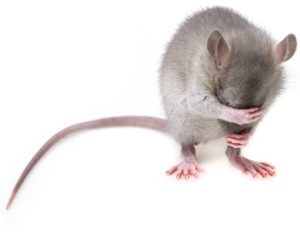 Oh, and, yes. Fifel is a rat. A big one, at that!

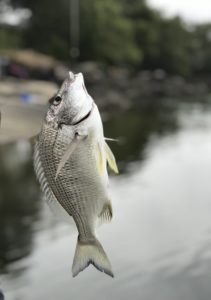 One evening we all got together and headed out to Lover’s Lane, a secluded area on the countryside popular for its fishing. Cloudless skies enriched our spirits while songbirds chirped at our arrival. Uncle Kenny went off to search for snakes, believing they hung out in good fishing spots. My brother, Ray, was tasked to keep near my mom to unhook and rebait her rod. Grandma tended to my cousin, Teeka, and I as we settled around the creek with our poles.
 I was grinning before Grandma even touched down, thinking, ‘That’s what her mean self gets.’
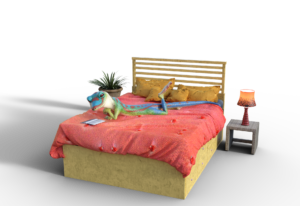 “His name is Joey – Joey Blue!” Dave exclaimed.
 Later that day, at about 3:30 PM, I was straightening my cell and I lifted my book from my clothes which were on top of my tennis shoes. And, there was Fifel – looking up at me, all warm and safe.
 Then, out from beneath the steel counter crawled an adorable, yet furtive, tot. She wore a teddy bear t-shirt, fluffed trousers, and her plaits were fastened with assorted hair bows. She whirled around to study me with cinnamon eyes that held me in their gaze. A subtle smile crept along her face before I watched her struggle to climb onto the seat, defiant of her pintsized stature. There was a fearlessness, a result of her naïveté, which left me feeling intimidated. I searched my thoughts for an explanation, but they only gave way to guilt. Her confusion was marked by an arched brow as the discomforting silence increased. She then rocked on her haunches, squared her shoulders and declared, “Hi. I’m Caleiyah, and you’re my granddaddy.”
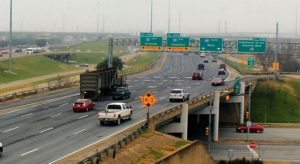 As I began to reflect, the silence became revealing. I noticed things I would’ve missed under other circumstances. My senses adapted with a sense of urgency. I knew the van’s muffler had to be busted because it made a hissing and popping noise every 45 seconds or whenever we slowed down and sped up again. I noticed when the driver loudly belched twice and gave a hearty laugh. Then he gave a doughy chuckle while he lifted his butt off the seat and released a silent fart that was ferociously smelly. Whatever he ate must’ve had a lot of onions in it. His partner gave him a displeased sideways look before he cracked his window, allowing the funk to exit.
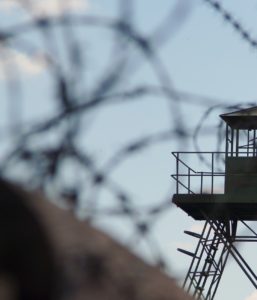 They took my chains and handcuffs off without a care of me attacking them. The guards seemed comfortable around the convicted, as if they’d accepted the idea that they were simply ‘inmates’ too, except they were getting paid to be there. Or their ease could’ve been due to the guard towers that held gunmen inside with their rifles aimed at me, ready to shoot with any sign of a snafu that I might cause.
 He would go on to ask me a bunch of questions that he fed into his computer. Questions like, “With a name like Mamou, what, you Muslim?” pronouncing the ‘s’ like a swarm of ‘z’s, in an effort to insult the religion.
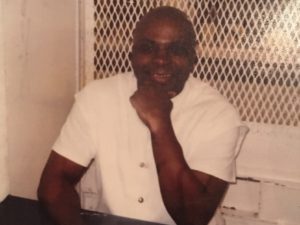 ABOUT THE AUTHOR. Charles “Chucky” Mamou is living on Death Row in Texas and currently working on his next novel. He can be contacted at:
 I am confined to a space designed to erase the last traces of humanity that remain after the war over my sanity.
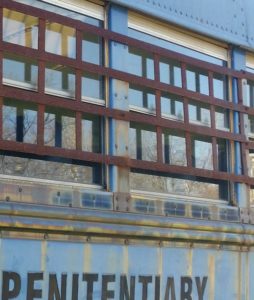 When I stepped off the bus at the Robertson Unit in Abilene, Texas, in August of 1994, I was 33 years old. I had no idea what was in store for me – I call it training day.