Category Archives: Views From The Inside

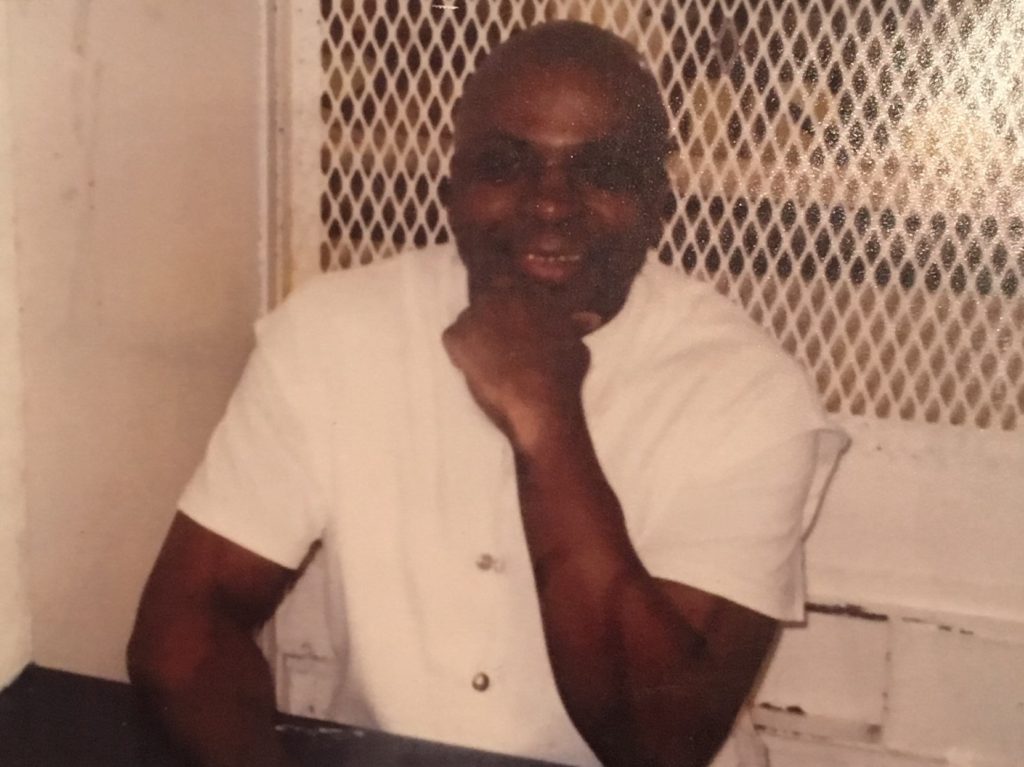
Isn’t Nearly Fifty Years Of Punishment Enough For Leonard Bradford-Bey?

Growing up in Detroit on Brady & Hastings in a once vibrant and bustling neighborhood where blacks owned several businesses and created jobs and livelihoods for many who resided there, Leonard aka Leanbone – a nickname given to him by his uncle due to his skinny frame – learned early on how to survive by adapting and finding ways to cope with the many challenges he faced.  It was during those years, he experienced his own personal trauma as well as witnessing police brutality.   Those experiences led him down a road of dysfunction, despair and destruction.  Leonard shared with me how his nearly fifty year incarceration has taken its toll on his health.  He now battles cancer, requires a cane in order to get around and has a prisoner assistant help him with his meals and other necessities.

Leonard attributes the path he chose in good part to bad choices and poor decision-making, which led him to a life of crime that ultimately resulted in a man losing his life during a stick-up attempt. Leonard expresses regret and remorse for the harm he caused the victim, their family, his family, the black community and society as a whole because that’s who was impacted by his reckless and out-of-control behavior.

This writer can relate to Leonard and the harm he caused because I am also responsible for a young black man losing his life to an act of senseless violence. It’s sad that we didn’t value the life of another human-being and acted so impulsively.  However, men like Leonard Bradford-Bey, who is now almost 70 years-old, realize the devastation of past criminal behavior.  He strives relentlessly to deter the same behavior in younger men and has become a well-known mentor and example that others can follow despite being behind bars.  Even so, as I peer into Leonard’s eyes, I see agony and shame for past deeds.

Leonard’s health is rapidly deteriorating, and at this point, with the life expectancy of a black man, he is living on what we call ‘borrowed time’.  The stress of having to deal with cancer and not receiving adequate healthcare can lead to more health issues. I have been around Leonard for the past 35 years or more and watched him go from an athletically-inclined, able-bodied individual, to that of a nearly handicapped man in need of constant assistance to get around on a daily basis. It saddens my heart and pulls at the core of my soul to see my friend become slowly debilitated before my eyes. If punishing offenders for crimes they’ve been convicted of includes this form of torturous madness, having them deal with life ending illnesses like cancer, heart disease, and kidney failure behind these bars – then I must ask… At what point is prolonged incarceration enough, especially if its met the threshold of its intended penological purpose? In other words, if the punitive and retributive aspects have been reached, why not then focus on the rehabilitative and transformative aspects of an individual’s growth and maturation out of criminality? Leonard has evolved and worked for his transformation, even earning a one year certificate towards his Associates Degree.

Over the last four decades, I’ve had to witness countless folks like Leonard suffer and wither away to near nothingness.  The reality of it hits home because I can honestly put myself in Leonard’s shoes as I am approaching the same age bracket and have serious health concerns as well. I realize that many of us have committed  terrible acts of violence, and people have lost their lives. However many of us, like Leonard, have shown and genuinely expressed our remorse and sorrow, shown sincere empathy, and taken full responsibility for our actions which led up to the crime and the offense itself.

In the early ’80s I was housed at Marquette Branch Prison, an old prison known for its vicious and volatile violence and stark similarities and resemblance to Alcatraz because it sits less than 50 yards off Lake Superior. One day a prisoner was aggressively harassing a young female prison guard who was terrified.  Leonard happened to walk up and see the fear in the guard’s eyes and the danger she was in. He immediately intervened and saved  her from harm. He didn’t consider the harm he was putting himself in, but that was Bradford-Bey for you. He wasn’t little Leanbone anymore, he was 6 foot tall and 260 lbs. – Grandman. He transitioned from being known as Leanbone to Grandman because he became a political activist and spiritual leader. He was a straight up cat, who didn’t particularly like to see anyone taken advantage of. I believe in my heart that if Leonard was to be released tomorrow, he could contribute something good to his community. If you were to talk with anyone here in the Michigan Prison System, I have no doubt whatsoever they would agree with me that he is the last of the Mohicans and surely a soul worth saving from this madness of prolonged unnecessary incarceration and the physical and mental suffering he deals with everyday. I pray the day comes they release Leonard and let him live the remaining days of his life on the other side of the gate.

Dedicated to Leonard ‘Grandman’ Bradford-Bey – From One Soul Brother to Another.

ABOUT THE WRITER. Ricardo Ferrell sent in the last entry recieved in a recent writing contest. I had never seen his writing before his essay arrived. Although the combined judges’ scores didn’t result in his placing in the top three – his essay got my vote for first place. He wrote with heart and compassion, which is exactly what this site is about. He became an advocate. Mr. Ferrell sent in an essay that was exactly what I was looking for when I started this contest – and he is my Honorable Mention choice. Ricardo Ferrell can be contacted at:

Ricardo Ferrell #140701
Gus Harrison Correctional Facility
2727 E. Beecher Street
Adrian, MI 49221



Loading

Farhenheit 451 Revisited?

I’m a student of prison philosophy.  I’ve pretty well seen it all in the quarter century I’ve been incarcerated, and I’m no expert, but I think that qualifies me for something close to a PhD (post hole digger).

This is about security, and don’t get me wrong.  I understand the need for prison security – keep the bad guys in, keep them from obtaining weapons of any kind, illicit drugs, pornography, things of that nature.  I’m not at all opposed to the security of whatever facility is being run for whatever purpose.  So, let’s not go there with the, ‘He’s just upset because he’s locked up’ BS (that doesn’t stand for Bachelor of Science).

But, I’ve come across an anomaly of biblical proportions.  I love books.  I always have, and I always will.  I’ve read nearly every book in our small prison library – some two or three times just to keep them circulating and available. 

Every six months they hold a semiannual lockdown/shakedown.  This is necessary to throw trash away, cleanse the unit of contraband and to sometimes instill order where there is chaos.  I’m not a big fan –  not simply because it’s uncomfortable, stressful, and sometimes (but not always) vindictive on behalf of a few officers who love to go through your property just to take ‘something’ that brings you comfort or happiness.  I’m part of a group of individuals who love books.  We’re getting to my point.

If you have books that aren’t clearly marked as belonging to you from the instant they enter the unit, they pile them up, like so much cordwood, and they throw them in the garbage.  Nuisance contraband…  And I don’t mean a few books.  I mean, literally, hundreds, possibly thousands, of good used books. Books which could easily be rounded up, bagged and sent to Goodwill or some other charitable organization – or the library.  Years ago, almost a decade, they’d confiscate books and put them in the library for times when an inmate couldn’t go to the library or it was closed.  Not anymore. 

It’s like the book by Ray Bradbury, ‘Fahrenheit 451’ when society bans books because they believe them to be evil or dangerous.  

I’ve never seen a book hurt anyone.

I’ve never seen a book change anyone for the worse.

Education is a key ingredient in eliminating ignorance.  If you’re smarter, you’re less likely to reoffend.  You’ll be able to fill out an employment form or an application for aid.  Reading opens up every avenue to the world – and a book never hurt anyone.

ABOUT THE  AUTHOR.  John is currently doing a two-year set off, after 25 years of incarceration.  He is a frequent contributor as well as author of Life Between The Bars, a unique and heartwarming memoir recognized by Terry LeClerc, “This book is so good because each chapter is short, has a point, doesn’t whine. It’s an excellent book.”  John can be contacted at:
John Green #671771
C.T. Terrell Unit A150
1300 FM655
Rosharon, TX 77583

All Posts By John Green.

Loading

All I Got For Christmas…

I should say, ‘All we got for Christmas,’ because it was actually for every TDCJ prisoner.  The new medical and dental copay is now $13.55 per visit.  That is an enormous savings for us, actually manageable.  Many prisoners who couldn’t, will now seek treatment.

The copay used to be $100 and forced prisoners to choose between medical care and having money to purchase necessities.  A prisoner that received $30 a month would have to pay that entire $30 towards the $100 the day of a doctor visit, and every month thereafter, TDCJ would take half of the prisoner’s monthly $30 until the $100 copay was paid off. This would leave the prisoner $15 towards his monthly necessities. Consider this list of supplies:

1 x Colgate toothpaste $2.75

1 x deodorant $2.50

15 x small bars Dial soap $3.00

1 x writing paper $2.00

10 x postage stamps $5.50

20 x envelopes $.60

Total is $16.35 – too much!!  The prisoner would be forced to remove some vital item(s) to get the list under $15.00, and forget about food to supplement the meager TDCJ meals.  No coffee.  No Christmas cards for loved ones.  All because they had to pay a $100 copay after they caught the flu or got bit by a spider (which happens with disturbing frequency).

A $13.55 copay!   A gift from the Texas legislature, but really from the public and the friends and families of prisoners. Those are the ones that pressured the legislature.  So, thank you all for your effort. The next time I need medical care I can get it without ruining any chance I have of keeping my head above water. 

Merry Christmas!

ABOUT THE AUTHOR:  Jeremy Robinson is author of The Monster Factory, which he is currently revising. Mr. Robinson lives in a Texas prison and can be contacted at:
Jeremy Robinson #1313930
Polunsky Unit
3872 South FM 350
Livingston, TX 77351

Loading

Guys Like Me…

Everything I do seems to fail,
And the shit is all to find a way out of my hell.

I sold dope to feed my hunger,
Not just ‘because’.

Ain’t no other way for niggas like me,
No matter how hard I pray or work for such things.

Yeah, I write,
But ain’t nobody paying for that.

Ain’t nobody gives a shit about the things
I write anyway.

Yet I try,
But trying don’t get me out of Hell.

Everything I ever wanted or wished for
Kept from my reach.

Love, opportunity, options,
All too far to grasp.

I’m broken inside
And tired of pretending I’m not.

My life is fucked up,
Not sure where to turn.

Don’t know what to do no more,
Been locked up my entire adult life.

Everything y’all have out there
Has been kept away from me.

Can’t get a hug and a kiss…
Let alone an opportunity.

No one really gives a fuck
About niggas like me.

We’re left in hell to suffer for things
We did when we were kids.

I’m hurting,
And I’m tired of hurting.

I’d die for an hour of freedom,
Just a moment of peace.

The love of a woman,
A hug.

To go for a walk
Not surrounded by gun towers and fences.

To sit with my family,
That’s what life is about…

I’m in a hell,
A hell that isn’t worth living for.

I know now,
Can’t no one help me out of this shit.

Some people come into this world to suffer and die…
And most, unfortunately, look just like me.

ABOUT THE WRITER: Michael Cannon is new to this site, but his feelings struck a chord. I hope we hear more from him. Mr. Cannon can be contacted at:

Michael Cannon #630831
Oaks Correctional Facility
1500 Caberfae Hwy.
Manistee, MI 49660

Loading

Defeat

I don’t know this Mr. Defeat
Of whom you speak.
Chances are me and dude,
We will never meet.
My enemies lie and cheat
To compete with my truth.
You are certainly right,
You don’t know me,
And I don’t know you.
But fact are facts
And real is real.
Yeah, I sold drugs,
But I never robbed or killed.
You say you feel my pain,
How could you
When it’s even too extreme
For me to explain
Without feeling strange.
I mean…
Imagine being buried alive
Not inside oak or pine.
This is concrete and iron,
Sometimes the sun doesn’t shine –
Hold on!
Wait!
Look at me when I am talking to you!
I could easily be YOU!


ABOUT THE AUTHOR. Rogers LaCaze once lived on Death Row, but was resentenced to life this past week for a crime committed in 1995. He maintains his innocence. Mr. LaCaze can be contacted at:
Rogers LaCaze, Sr. #356705
CBB L/L L.S.P.
Angola, La. 70712

Loading

This Is How Monsters Are Made

Human beings that can, at times, be so caring and helpful, thoughtful and graceful, can at other times be so very ugly.  When you place a man amongst a group of men that do not possess the saving graces…  a group of men that is nothing but ugly, things can go very bad.

I often hear on my FM radio snippets of humor.  Or a commercial.  Maybe a child speaking candidly, which is humorous or touching.  I hear a thirty second piece of humanity – a piece of the real world. 

I have lost the laughter of children.  Lost a million tiny human interactions that create warm, happy, positive feelings.  I have gained violence, anger and willful ignorance.   I have gained mean spirited humor and more forms of discrimination than I can name properly.  I have gained a million negative pieces to replace the million positive pieces… and I despair.

ABOUT THE AUTHOR:  The above is an excerpt from Jeremy Robinson’s, The Monster Factory, which he is currently revising. Jeremy lives in a Texas prison and can be contacted at:
Jeremy Robinson #1313930
Polunsky Unit
3872 South FM 350
Livingston, TX 77351

Loading

Solitary Confinement

I didn’t realize my ‘normal’ wasn’t normal until I got transferred to a less restricted housing unit.  Before that, my normal was trying to sleep through the yelling and banging, being forced to show my genitals, including bending over and spreading my cheeks, every time I left my cell – hands cuffed behind my back once I did. 

The ‘normal’ I was being subjected to was making it less and less likely that once released – I would be able to function around ‘normal’ people. 

I just hope my new normal will undo the damage my old normal caused…

ABOUT THE WRITER: Mr. Reaves is a new writer to our site, and I hope we see more from him. He said a lot in four sentences – I’m excited to see what he sends in next. Mr. Reaves can be contacted at:

SC – Sterlin Reaves DX-5999
P.O. Box 33028
St. Petersburg, FL 33733

Loading

The First Thirty Days

Solitary confinement is exactly that…  solitary.  There are a lot of people who live there, but because they are each locked away in a separate box, it’s easy to forget there are people around you.  I spent almost twelve years in solitary, twenty three hours of every day in my cell and everything brought to me.  I was only just released over forty-five days ago. 

While in solitary, inmates are handcuffed and escorted any time they leave their cell.  Literally.  So for nearly twelve years, every single time I would go to a visit or medical, there were two staff members on each side of me. 

The day I left solitary, I was no longer cuffed and had no escort.  I walked out of 12-building – alone… to join a line of inmates that were getting on a prison bus to go to a new unit.  To say that I felt very weird – conspicuous – would be an understatement.  I can’t overstate how uncomfortable I felt.  I knew that it would be a tough transition, and for months I had worked hard to prepare myself, but in real time, the feeling of displacement was overwhelming.   Had a person been able to hear my thoughts, they would have heard an almost psychotic back and forth monologue with myself. 

‘People are staring at me…’

‘Yes!  This is what you WANTED, dummy!’

 ‘Where do I go now?  Where do I walk?’ 

‘What’s next…’

I didn’t know anyone and was struggling to converse, to keep eye contact.  I found my voice wasn’t loud enough, and I was mumbling.  It all affected my confidence, which compounded the problems and made them worse.  I couldn’t believe what was happening.  Apparently, having an awareness of the problem wasn’t going to be enough to solve it.  Even as I write this, after a month and a half out, I feel stupid trying to convey the sense of displacement. Solitary damaged me, hurt my ability to relate to others in a normal way.

I was in solitary for attempting an escape.  The policy on this states that I was to be released after ten years, but TDCJ had other ideas. The policy also states that the security tag, called a ‘Security Precaution Designator’ was to be dropped after ten years.  Of course, TDCJ refuses to drop the designator, and rather than release me to minimum custody, where I rightfully belong, they released me to the most restrictive level of custody, G5.  G5, aka ‘closed custody’, is very violent and full of drugs.  Walking into the section, I could smell K2 burning and see all the walls and doors had burn marks from fires being set.  The noise level was high. 

My first cellmate was just thirty years old and only had twenty-nine months left until he discharged his sentence flat.  This meant he had no incentive to behave well.  He didn’t care about making parole. He was also what’s called a ‘wet head’, meaning when he was free, his drug of choice was marijuana laced with embalming fluid. Sadly, this had damaged his mind.  He could hear invisible people whispering, and believed a female CO and an inmate were having sex behind the toilet. He was jittery and very suspicious.  I’d been in the cell – my very first cell since leaving solitary, mind you – ten days, and he hit me.  We fought, and the sergeant moved both of us to new cells.

My new cellmate was also a ‘wet head’…  I wasn’t in the cell five minutes before we were fighting. This cellmate refused to let me unpack my property, going so far as to try and restrain me.  I’d been out of solitary for less than two weeks and had participated in two fights and seen at least fifteen.  I was very discouraged.

The next cellmate was okay.  We got along for a few weeks, and then TDCJ moved me from G5 to a better custody level – G4.  Here I can walk to the chow hall and eat.  I get four hours a day out of my cell.  My first day out I wanted to mail a letter but didn’t know where the mail drop was.  Of course I didn’t want to reveal my ignorance and ask, so I waited until chow and followed a guy that had a letter in his pocket. Once at the chow hall I sat wondering where the salt and pepper shakers were and how to get my cup of juice refilled.  Apparently, one simply holds up the cup and the inmate worker… I hesitate to call him a waiter… refills it.  After eating, I followed the other inmates back to our section and then copied them as they racked up, went into their cells. Each day found me imitating some other inmate’s actions, relearning basic things about schedules and rules. 

It’s been almost fifty days of fear and uncertainty.  I find myself longing for the solitude, the safety and the predictability of solitary confinement, having to forcefully shift my mental gears to appreciate all the good things that come with being in population.  I attend church and am to begin school soon. I got a sunburn.  Yes, a happy occasion after twelve years without sun.  I get fresh air and hot food – the quality hasn’t improved, but it’s no longer cold and spoiled.  Soon, I might receive a visit with my children, contact rather than through glass, and I’m allowed to use the offender telephones and speak with people.  I remind myself daily that ‘predictable solitude’ becomes a very lonely place. I’m still lonely, but now I at least have people around me.

There’s no doubt that not only does solitary confinement damage inmates, but that the damage is more insidious, more subtle than I could have ever believed.  If the transition from solitary to general population was this difficult for me, how… almost… impossible will it be for me to integrate into society after having served thirty flat years in prison?  Do not read that wrong. I haven’t given up.  I will continue to improve.

ABOUT THE AUTHOR: Jeremy Robinson is author of The Monster Factory and is currently working on several projects. He can be contacted at:
Jeremy Robinson #1313930
Polunsky Unit
3872 South FM 350
Livingston, TX 77351

Loading

Vivere Senza Rimpianti!

I hate being on Texas Death Row.  The air.  The stripping nude four times a day on average so officers have something to do or look at.  The cold, faux-food.  The redundant radio station playing the same ole’ commercialized songs every half hour.  I hate my current existence so much, I even hate telling you about it.

We’re all enigmas here.  Each emotionally abused and scarred in some way, shape or form.  This is a place where a guy named Marty McFly can change his name into something catchy and it sticks like a new skin – Big Mac, Marty the Leotard, Mc-Dawg.  Guys can rename themselves after their city, town, zip code, favorite animal, or even a car – something they never would have thought of had they been free.  That’s one thing I don’t hate.  I find the names quite creative and the choices interesting.  At one point, I went by the name Louisiana because others couldn’t pronounce my last name correctly. 

In some regard I think I’m better off than some in here, having battled my own thoughts of suicide and self-harm.  There are times that are comforting, like when it’s quiet and I can read a good book and see the words come to life on the inner stage within my mind.  There’s nothing greater than that.   

Then – there’s visitation.  I love getting visits and a chance to get out of this cell, to be allowed to interact with ‘freeworld’ people and have a moment of nostalgia.  I saw a kid race another across the floor, and it brought back memories of seeing my own daughter doing the same exact thing two decades earlier. 

I wasn’t much of a talker when I was free, but I’ve since acquired a taste for conversing.  People fascinate me and I want to know and understand how they see the world, and how different cultures can be. 

I recently did a BBC interview with a lovely reporter.  It was my understanding the segment was to be focused on my beloved friend, Mary, who was here to visit me.  Perhaps I understood the angle.  Perhaps I didn’t.  Or, maybe, I was a self-centered bastard who thought that – once the camera began to roll – it was ‘action time’ and all about me.  Which would explain why I wanted to shave away the grey hairs from my face before the interview.  Why I urgently smoothed the Olay moisturizer sample I received inside one of my girlie magazines on my face to give me a glow when the big lights came on.  And maybe it explains why the first thing that came out of my mouth was, “Where’s my glam team?”

A few days before the interview I had to have a tooth removed, and I found myself talking on the opposite side of my mouth so the camera didn’t catch the side-gap in my mouth.  I am many things – true.  Add ‘vain’ to the long list.

I attempted to change the narrative of the interview by talking about me, my case and this environment as the British reporter shifted right to left in her chair out of patient frustration.  She was chasing a story.  I was chasing freedom and wanted the world to know it while I still had a chance to express it.  I could tell she ‘understood’.  Somewhere, hidden beneath her eyes, she knew I was a lonely soul, cast into a lonelier sea.  I may have seemed a bit ornery to her, or she may have even thought I was a meshugana.  I’ve been called the latter a few times. 

The reporter was a true pro.  Smooth.  She sensed it when my own oxygen began to run out.  She had to have seen it in the finality of my expressions.  The desperation of my emotions.  The expression of agony of two decades of being mentally lynched within the halls of solitary confinement. 

“Can I ask you one final question?” she asked with a smile.  I invited her to ask me anything, confident that nothing asked would be too complicated for me, until she asked, “Do you have any regrets?”

Mentally?  I began to perspire.  Emotionally – I could see air-bubbles form with no words.  I was caught off guard.  Speechless.  Suffering from a ten-second delay of censorship.  Was this a trick question?   Was she asking about my case?  My life as a whole?  I was truly confused and didn’t like it.  I rubbed my head, looked into the camera and explained that I was innocent in every way from the conviction that molested my freedom from me.  Sure – it wasn’t what she wanted.  But, it was what I needed.  I needed to say it.

I’ve been told an Italian saying that goes, “Vivere Senza Rimpianti” – to live with no regrets.  And when I came back online mentally, that was the only thought I had.  So, I told her, “I have no regrets.”  Perhaps I regret saying that without fully explaining what I meant.  Perhaps not.

What no one can see is that I’m not the same person I was when I was free, thinking I knew everything about everything, when in reality I knew nothing about anything.  I’ve traded in gangster rap lyrics for informative literature.  I now get intoxicated on history, philosophy, politics, psychology.  Not beer, wine or champagne.  I’m a different person today because…  and I HATE to admit this, but my limited environment gave me access to unlimited knowledge.

Since I’ve been on death row, I’ve met so many people from all over the world.  People I have no doubt I would have never encountered had such a wicked kismet not fallen upon me.  People I love more than I love myself.  People who have educated me, visited me, defended me and my innocence and have taken care of me as if I was always one of their own.  A love that transcends mere words of affection.  A love that does not judge my past, but supports my future.  A love that isn’t defined by social acceptance or traditional neglect for those like me who are incarcerated. 

I believe that if you regret some things, you will learn to regret all things.  I love who I am.  It’s my past mistakes that have made me who I am today.  I learned from them.  I grew from them.  You can wish that certain outcomes never happened the way they did, but regrets?  Traditionally, our mental wells have been poisoned into not challenging clichés and social norms when we know a challenge is needed. 

When I told the reporter, “I regret nothing,” I meant that.  For I could not and do not want to entertain an existence where I live without my friends who are family.  I wouldn’t trade my freedom for them.  Living would be a ‘regret’ if I didn’t have them in my life.  Vivere Senza Rimpianti! 

ABOUT THE AUTHOR.  Charles “Chucky” Mamou is living on Death Row in Texas.  He is out of appeals and has always maintained his innocence.

He can be contacted at:
Charles Mamou #999333
Polunsky Unit 12-CD-53
3872 South FM 350
Livingston, TX 77351

Writing By Charles Mamou

Loading

What Will My Legacy Be?

Having served over 38 years, guilty or innocent, I wake each morning to the profound reality of doing life in prison.  This is not what I or any man was created for.  But here I am in a box, caged like an animal, and as the tours come through, I’m often looked upon as such.

Yes, a man, a human no less, but looked at and treated as other than, the wretch of the earth.

I have a friend who wrote a book titled, ‘A Costly American Hatred’. His name is Joseph Dole. In the foreword he states, “At one time lepers were segregated from society and exiled for life to leper colonies.” A new type of leper and leper colony has taken their place in America. People who commit crimes are the new leper.  The new leper colonies are prisons, sprung up across our nation like Starbucks.

Doing life is not easy, and one has to adjust and continue to adjust as the hours, days, months and years go by.  And as life – your life, my life – plays out, one has to remain hopeful. I first entered prison without a care.  I still had a woman and family. In a span of a few years, they were gone. The losses unimaginable.  I spoke to my mother on the phone weekly and got an occasional visit, but life as I knew it changed the moment the judge found me guilty.

When you enter the belly of the beast, trust me, your life will change too. That’s a fact.  I had no heart when I first arrived. I was as cold as the steel that confined me. I often applauded the misfortune of others that played out on the news and before my eyes.  Sometimes, I played a part in the demise. I was a young son with an estranged woman, who became hooked on drugs.  I had a mother trying to be the conduit of help and a good grandmother while also a parent to me.  I was doing time, gang-banging, getting high and doing much of what I had been doing on the street. I was numb to the time I had to do. I had yet to realize I was doing the best I could to escape reality.

Each year time gets harder as the prison industry dries up. The prisoncrats took back their prisons and commerce has dried up as well.  As an artist, the end of arts and craft shows and being allowed to sell our art to officers and visitors was a game changer.  I went from earning a few hundred dollars each month to depending on a state stipend of $10.00.  Trust me, that doesn’t go a long way in prison these days.

Now I sit here with no family, my mother gone, and a brother who hasn’t spoken to me or my son in over twenty years.  There is no other family.  I had a woman for over twenty of the thirty plus years.  She was a rock in and out of my life. She would help me weather many a storm, but at seventy plus years of age and chronic everything, time has crippled her in many, many ways.  Years have gone by, and I haven’t heard a word from her. Time waits for no one.

I too have aged.  I’m blessed to have my son here with me in prison, but it’s certainly not where I want him to be. As an elder, our relationship affords me a bit of comfort many my age do not have here. Life has taken a toll on my body, but not my spirit. I hold on to hope and dream of being free! But I also face the awesome reality that I may die in here. That’s real and something I think about often.  I ask myself, what will my legacy be?

Up until the point when I changed my life, I was en route to further failure and the banner of having been born and died and absolutely nothing else. It’s my hope, my fervent prayer, that my legacy will be that of a man who helped shape the futures of young men who came through this penal institution, especially those now in the free world.  I hope that I have helped them change their lives for the better, and that I have given some hope, some insight into making better decisions.

As for my son, I am honored to have shown him the other man, not the gang-banging, ice-cold, uncaring man who caused harm and damage to men, women and community, but a visible man of Yah (God).  A man who shows and teaches the lessons of love, respect and compassion.  A man who shows how important it is to extend our hands to our elders.  A man who has always extended his hand to the many sons I’ve adopted during my journey in prison.

I want my legacy to be that I was a man of Yah, who with each new breath of life represented the banner of my holy name – Ananyah – which means, he has covered or the covering of Yah (God). I would like my legacy to be that my writings I once did for the youth on life from lock down, provided a teachable moment, a vision, and led readers to see, know and hear the truth of my words.

I want you to think of your favorite part of the day, when everything else stops. Taking your children to the park, the warm embrace of a loved one, waking to the one you love, or just a simple cone of ice cream. Your favorite home-cooked meal or a nice refreshing shower.  Now, imagine that moment gone forever – that’s doing life in prison, my friend.

A sentence of life without the possibility of parole, is a death sentence, but worse.  It’s a long, slow, dissipating death without any of the legal or administrative safeguards rightly awarded to those condemned to the traditional form of execution. Life in prison is indeed the other death penalty. It exposes our society’s concealed belief that redemption and personal transformation are not possible, thus no one is vested in us except for the monetary value our incarceration provides.

You have the ability to chart a new course has always been my belief and message. I’ve expressed concern to the youth and parents of youth in hope they avoid sitting in one of the many cells available in the US Penal System – like I am.

ABOUT THE AUTHOR. Kenneth Key is an accomplished artist and writer and can be contacted at:
Kenneth Key #A70562
P.O. Box 112
Joliet, Illinois 60434-0112

Loading